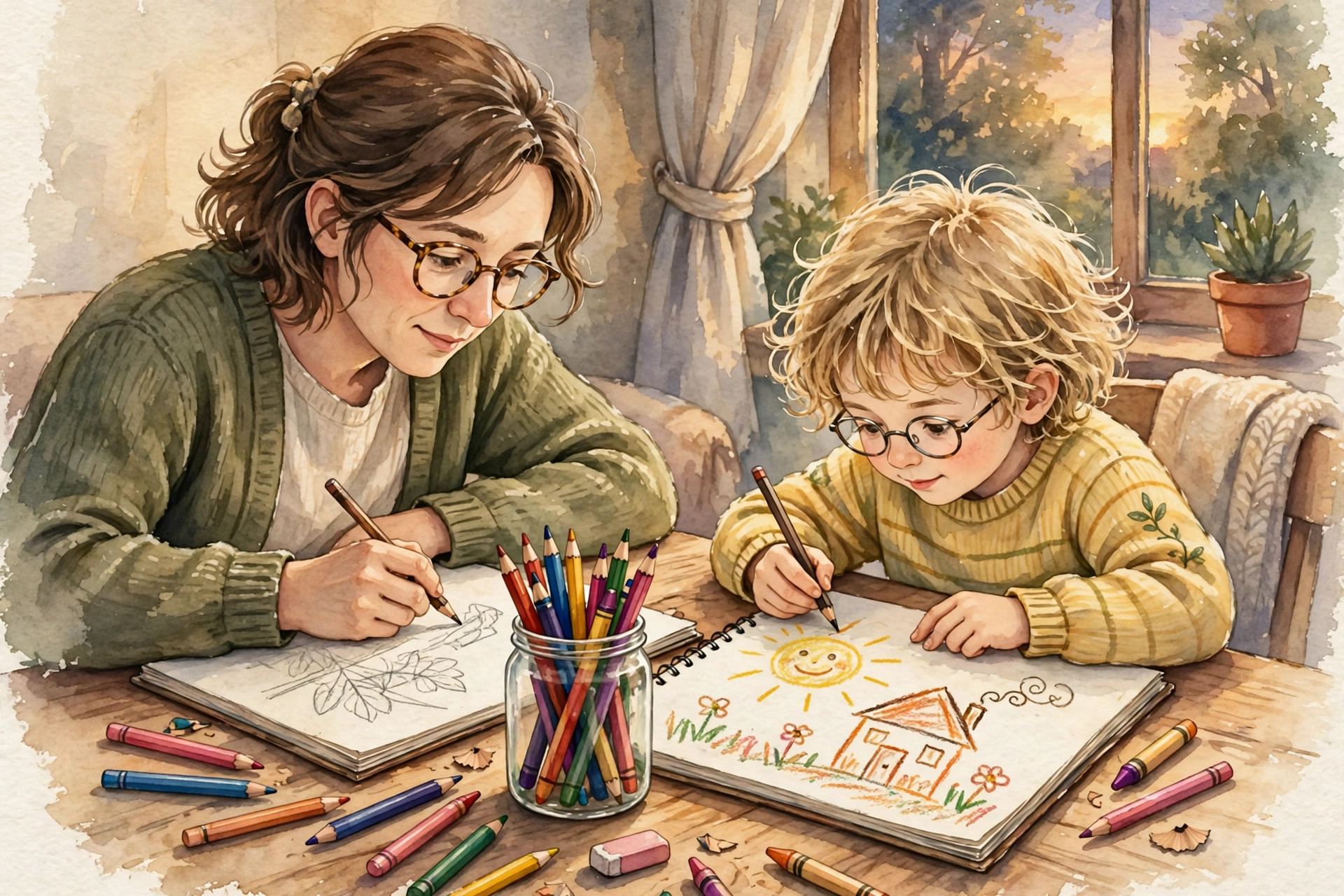
What "I'm bored" actually means
When a child says "I'm bored" about drawing, they almost never mean they are bored. They mean the gap between the picture in their head and the picture on the page has gotten uncomfortable — and the page is where that discomfort lives. So they close the book.
That gap is normal. Every person who draws has it, at every age. The job is not to remove the gap. It is to make the book worth opening anyway. Here are twelve ways, in roughly the order they work.
1. Shrink the assignment
If "a drawing" is the task, a child's brain files it as a performance and files it under "later." If "one line for sixty seconds" is the task, it is too small to be scary. Do the sixty seconds. Usually the line wants company.
2. Draw with them
The single most effective thing on this list. Sit down, open your own page, and draw badly next to them. Not "helping." Drawing. Your bad dragon next to their bad dragon is permission: the page is not a test, it is a table where people draw.
3. Ban the word "real"
"Draw a real horse" is a trap — it tells the child there is a correct horse and theirs is not it. "Draw a horse with wings" has no correct answer, which is why children finish it. Fantasy is not a detour from drawing. For a child, it is the road.
4. Change the tools
A different crayon changes the line, the speed, and the feel of the hand — which means the old bad habits don't transfer. A fat marker after a week of thin pencils feels like a new medium even when it is the same hand. New tools are the cheapest reset there is.
5. Make the book smaller
A full-size sketchbook during a dry spell feels like a stadium. A pocket notebook feels like a napkin. Draw in the napkin for a week. Small paper means small stakes, and small stakes mean more lines.
6. Give the drawing a job
A drawing with nowhere to go dies on the fridge. A drawing with a job gets finished. The best job there is: it becomes a book. Tell your child their dragon could be in a real storybook — a personalized storybook made from their own drawing — and watch what happens to the next page. A child who knows their drawing might become a book draws like it matters, because it does.
7. Display it, properly
Not the fridge, with a magnet, next to the shopping list. A frame, a wall, a shelf — one drawing, chosen by the child, displayed like it belongs there. Children draw more when drawing is treated as something worth showing.
8. Set the timer, lower the bar
Twenty minutes, one subject, no fixing. The timer matters more than the subject: a bounded task can't become an identity test. When it rings, close the book even if the page is "bad." Stopping while it's bad is the whole training.
9. Draw with a constraint
One line, one color, one minute, left hand, from memory, from sound. A constraint turns "create" into "play." The boredom can't find you in a game.
10. Copy, with permission
Find a drawing they like, copy one page, slowly, line for line. Copying is not cheating; it is a scale you put your hand on. And it quietly proves the thing they're afraid of: their hand can do this, on the right day, with the right teacher.
11. Show it to someone
Boredom feeds on an audience of one, because the audience of one is the child and the child is their own harshest critic. One kind person seeing the page, out loud, breaks the loop. A grandparent. A friend. A wall in the kitchen that the whole family can see.
12. Re-open the old pages
This is the one that usually ends it. Open the book from a year ago. That page they would have hidden? They would keep it now. They have grown into the drawing that used to hurt. The gap was never their hand — it was their eye, arriving early.
The order that works
Start at 2 — draw with them. If the page stays closed, go to 1, then 5, then 6. Most children are back to daily drawing inside two weeks, not because they "got inspired," but because the gap narrowed enough that the book stopped hurting.
The gap will open again. That is the job. That is the whole job: imagination out front, hand in pursuit, and a book open between the two — and sometimes, a real book at the end of it, with their dragon on the cover.
You don't draw to feel creative. You draw to find out what you actually feel.
Make their drawing into a book
When the next dragon comes out well, don't let it die on the fridge. Turn it into a personalized storybook — the book is $19.99, the movie $34.99, and the two together $44.99. For the holidays, start at the personalized Christmas books page.